We had gone in with (some) laughable concerns.
Male Infantry Officer, ITB-East, 2013
As the staff at Infantry Training Battalion (ITB) began planning, they thought through expected challenges. What would be different about training women than training men? For the women in my audience, your reaction might be, “not much”. But the men at ITB didn’t yet know that. One thing they thought about? Feminine hygiene products.
Why? Several reasons, the first of which was . . . the packing list.
Ah, the packing list. The place where the Marine Corps (or your Company Gunnery Sergeant) tells you to bring 5 pairs of underwear and 6 pairs of boot socks (now you know the value of clean, dry feet). The packing list gets very specific because when you’re in the field, there’s no running back to get something. There’s no running to the store because you forgot your toothbrush. You’ve got what you’ve got and that’s it. So you better not forget anything.
This is especially true during entry-level training, when recruits or new Marines haven’t yet become accustomed to double or triple checking their packs prior to a field exercise. The packing list also exists so Marines cannot “know better”. Do you really think you only need 3 pairs of socks? Ok, until your feet become blistered and bloodied. Then you’d wish you’d brought all 6 pairs, and dealt with the additional weight.
The packing list includes items like medication and razors (because being in the field does not negate the need for a daily shave). When the leaders at ITB started planning for women’s initial entry, they had to consider adding feminine hygiene products to the packing list. (seriously)
One leader told me that, “we struggled with that for about a month”, with questions like,
What do we need to have? Where do we get it from? When do you provide them? Is it something you quietly provide? Is it going to create a stigmatization of these new Marines?
Marine Officer, ITB-East, 2013
Another reason? For Marines in the field, very little is private and everything must be considered. There are no bathrooms (in many field situations). How does one take care of the basics? Feminine hygiene products were at the forefront of their minds, but everything else must be considered as well.
My favorite (also laughable) memory took place during the officer version of Marine Combat Training. We were in the field for several days, and there were absolutely no bathrooms. I had to pee. Of course, we had set up a security perimeter (imagine a dozen Marines formed in a circle, lying on the ground with their rifles pointed outwards). Where exactly was I supposed to go?
Well, since we weren’t actually in a combat situation, I departed the security perimeter. It was autumn. The leaves had fallen and trees were sparse in that area, so I had to walk a distance before I found a tree sufficiently large to provide the necessary coverage. I was a bit paranoid. I did not want these men to watch me pee.
After completing my mission, I looked around and wasn’t sure which way led back to my unit. I’ll never forget my mortified embarrassment as I wandered for a few minutes. I didn’t panic, and eventually did find my way back. But not before they sent someone to find me. The trials and tribulations of being a woman in the field never really end.
Granted, officers are expected to take care of themselves and figure some things out on their own. Conditions are often a bit more austere in officer training. Enlisted generally have closer supervision and direction while they’re in training. So what did the leadership at ITB do? They brought in three enlisted women – staff non-commissioned officers (SNCOs).
Who were these women? Where did they come from?
As it turns out, from across the street.
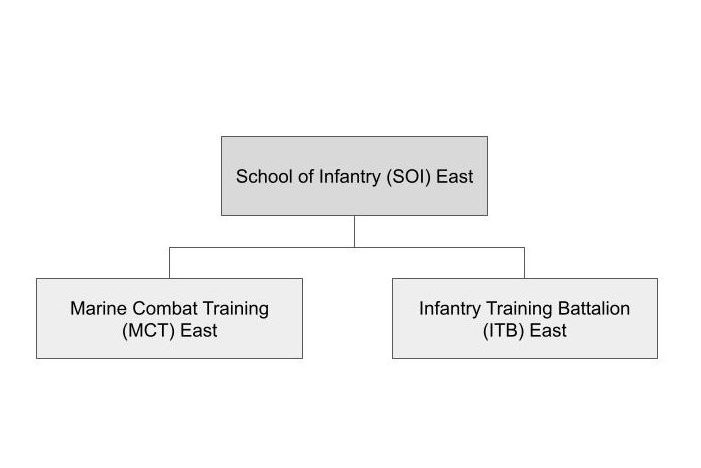
Have you heard the phrase, “every Marine a rifleman”? That is actually something so important to the Marine Corps that it sends all (enlisted) Marines to the School of Infantry (SOI) after graduating boot camp.1 There are two training battalions at the School of Infantry. For the infantry Marines, they go to Infantry Training Battalion (ITB). For the non-infantry Marines, they go to Marine Combat Training (MCT) Battalion.
This is the training that marks the transition from entry-level Marine to combat-ready Marine. At SOI, recently graduated enlisted Marines continue their education and training to become more proficient in the fundamentals of being a rifleman. Marines with a Military Occupational Specialty (MOS) of infantry are trained at the Infantry Training Battalion (ITB), while all non-infantry Marines are trained at the Marine Combat Training Battalion (MCT).
School of Infantry (emphasis added)
Marine Combat Training (MCT) is a 29 day course that trains all non-infantry Marines to be,
. . . a fighting Marine, regardless of their Military Occupational Specialty (MOS). Training includes marksmanship, combat formations, and patrolling, as well as other combat related skills.
Each battalion has instructors, called Combat Instructors (CIs)2. At Infantry Training Battalion, all the Combat Instructors were men. At Marine Combat Training Battalion, some of the Combat Instructors were women. This is the place from which Infantry Training Battalion leadership got its female instructors. Leadership from each unit – the School of Infantry, Infantry Training Battalion and Marine Combat Training Battalion – coordinated to ensure that there was female leadership at Infantry Training Battalion for the female students coming through.

The primary purpose in bringing the female Combat Instructors over was to provide positive examples to the female students. They were also supposed to provide mentorship and a person with whom the female students could speak about sensitive issues (which they might not want to discuss with a male Combat Instructor). For the male Combat Instructors, these women would prove that women could perform well. (This topic deserves its own post, and will be discussed in depth in a future post)
When the women arrived at Infantry Training Battalion, they became part of the planning team. When it came to feminine hygiene products, they said, “why are you spending time on this? You’re not going to see this be an issue”.
For the female Combat Instructors, who had dealt with this for years at Marine Combat Training Battalion, it was simple. Put it on the packing list. Hold Marines accountable for bringing everything that is on the packing list. They said, “you’re not going to have anyone raising their hand, saying, ‘I can’t train because I don’t have feminine hygiene products.'”
Before these women, the men had “spent hours on this”.
These revelations reminded me how much I took for granted – all the things that I and other female Marines have figured out over the years, which are now simply a matter of course. It reminds me why (in small part) women’s integration was so significant for the infantry community.
Friends often ask me, “don’t they (infantry Marines) have mothers, daughters, wives, sisters?” Yes, they do. But rarely do any of those women go to the field, train for combat operations or do many of the other things that Marines do. Many infantry Marines had never worked with women before at all. Even male infantry officers only saw women at their entry-level training. They might not see a female Marine again until they were on a headquarters staff.
I and many of my female counterparts often thought it ridiculous to bring in senior women into units that had previously not integrated women. Just treat everyone like Marines. But that was our perspective, and our misunderstanding. Integrating female leadership first provided several benefits, more of which I’ll discuss in future posts.
REFERENCES
1For officers, it’s The Basic School (TBS) or Basic Officer’s Course (BOC). (Please do not ask me why it has two names. It’s ceaselessly confusing for us as well.)
2Boot camp had drill instructors; Marine Combat Training Battalion and Infantry Training Battalion had Combat Instructors.
 Breaking Into the Brotherhood
Pingback: Equipment (Enlisted Infantry Training) – Breaking Into the Brotherhood
Pingback: The Unit Family (Enlisted Infantry Training) | Breaking Into the Brotherhood
This reminds me of the time NASA asked Sally Ride if 100 tampons would be enough for 6 days in space.
LikeLike
Yes, exactly!
LikeLike