Everybody gets one.
All the planning in the world cannot prepare you for everything. We joke in the Marine Corps that “proper prior planning prevents . . . poor performance”. We usually say this after someone has failed to plan and suffered the consequences. We also say, “no plan survives first contact”. Essentially, this means that as soon as a project gets underway, the plan kind of goes out the window. When it came to integrating women into Infantry Training Battalion, leadership planned for some things that they really needn’t have. They planned for some things that they really needed to (future posts on this topic). They didn’t plan for those things they simply didn’t see coming.
When it comes to equipment, you generally get what you get. The Marine Corps philosophy has had a one-size-fits-all mentality for decades. Originating from the industrial model of production, the Marine Corps designed many pieces of equipment to produce as many as possible for the lowest cost. Bonus? One-size-fits-all pieces of equipment are interchangeable. If you find yourself without a sleeping bag or pack, getting a new one is relatively easy.
The Marine Corps used the average sized male Marine in its one-size-fits-all model. If you happen to be five foot ten inches tall and 175 pounds (the average male Marine), you’re all set. If you happen to be five foot four inches tall (the average female Marine) or even six foot four inches tall, you might find yourself struggling to make things work.1 In the Marine Corps’ institutional mind (and for many Marines on the ground), the one-size-fits-all model literally means one size, fits all.
This creates a culture in which Marines become mentally tougher, certainly. They become more creative in developing individual solutions.
It also creates a culture in which Marines suffer in silence. They make do with ill-fitting equipment. Or they devise workarounds that may compromise their combat effectiveness and/or lead to injury.2
It starts at initial training. Get in line. Take one of each (or however many you’re supposed to have). One sea bag, one pack, one helmet, one flak jacket, one rifle, three sets of utility uniforms, one pair of boots, etc. Remember the packing list? There is also a gear list – all the Marine Corps issued gear which one must take on a hike, to the field, on deployment.
The first week when we bring students in, we spend all the time issuing gear and going through how to wear it. We introduce internal SOPs (standard operating procedures) for the squad bay, how you pack your pack, and (explaining) the things will be different when you’re out on the road.
It should come as no surprise that one-size-fits-all doesn’t actually fit all. Two items particularly stood out at Infantry Training Battalion. First, the rifle. Wait, what’s wrong with the rifle? Could there be a more one-size-fits-all piece of gear? Maybe, maybe not.
The leaders at Infantry Training Battalion ran the female Combat Instructors through some of the ITB weapons ranges. One of the female Combat Instructors came to leadership and said,
I’m having trouble with this weapon (M16A4 rifle). I’ve had this problem since I came into the Marine Corps. The weapon is too long. With my shortened arm, I can’t get the cheek weld or the stock weld (in the right position) according to the fundamentals of marksmanship . . . I can’t get my eye under the scope right.
Leadership made a decision to issue any Marine, under a certain height, the M4 instead of the M16A4. This meant that instead of having a rifle that was 39.5 inches long with a 20 inch long barrel, shorter Marines had a weapon that ranged from 30 to 33 inches long (depending on whether the stock was retracted or extended) and a 14.5 inch barrel.
Note that leadership said, “any Marine under a certain height”. They did not differentiate by gender. Though the average male Marine was approximately five foot ten inches tall and weighed approximately 175 pounds, many infantry Marines fell far short of this. Data at the time of the research revealed that 3% of male infantry Marines3 were five foot four inches tall (the height of the average female Marine) or shorter. Yes, shorter.
We made a conscious decision that it would be either male or female of a certain height (if we had weapons available in the armory). So it wasn’t about gender. Arm range was the problem.
Having figured out the rifle issue, the helmet presented another challenge. This one was related to gender.
Ah, the helmet. My nemesis all through training and the reason I firmly believe that my training amounted to virtually nothing. For of course I could not see anything with the helmet tilted in front my eyes. I was completely combat ineffective, regardless of my strength, stamina or any other physical measurement. I was constantly pushing the helmet back in an attempt to see, until I finally gave up. I realized that none of my instructors cared whether or not I could see.
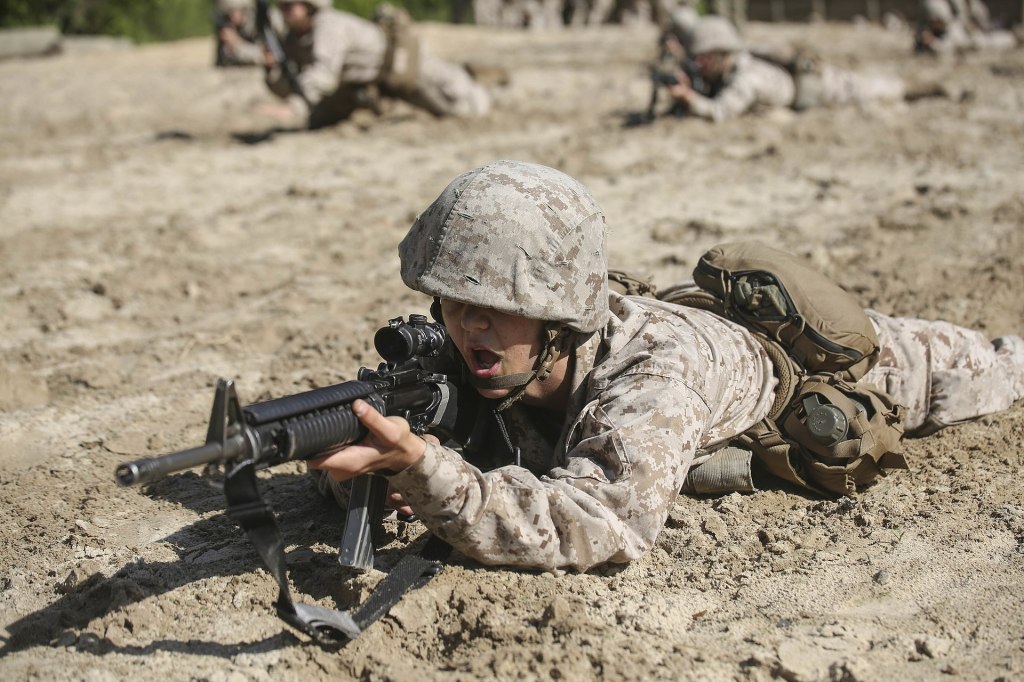
In the prone (position), you’re laying flat and your natural inclination is to look directly at the dirt, right underneath you. To fire the weapon, you have to crane your neck back to get your head up and downrange back to the target. When you crane your head back, a female wearing a tight bun (or tucked up braid) puts pressure on the helmet and it naturally slips forward.
Again, one of the female Combat Instructors who had joined them from Marine Combat Training provided some ideas to mitigate this challenge.
The bun created problems . . . The helmets issued then had pads to keep your head away from the metal of the helmet. We were trying to take the pad that was in the back of the helmet out to create a space for the bun to fit in. All these things female instructors were having to teach our male instructors. Some of them had already learned and adapted at MCT (Marine Combat Training), but this was foreign to our (male) instructors. You have to actually take the time to show this.
Another method to keep the helmet in place involved using boot bands to connect the helmet to the flak jacket, and thus keep the helmet from tipping forward. The Combat Instructors took the extra time during the first training week, when they issued gear, to have the female students figure out the helmet before getting to the rifle range. They had them lie in the prone in the squad bay4 with their helmets on and asked, “Can you see the target through your sight?”.
One might think that it would be easy enough to let the bun or braid down, alleviating the necessity for a workaround. As of this date, the Marine Corps still mandates that hair remain secured in anything other than a PT (physical training) environment.
Likewise, it seems commonsense that a shorter Marine (regardless of gender) should be issued an appropriate weapon. The Marine Corps has made a few changes since the research took place. In 2015, the M4 became the standard weapon for all infantry Marines (non-infantry Marines continued to carry the M16A4). The Marines largely applauded the move, as many have “long complained that their legacy rifle was too long and unwieldy for urban and vehicle-borne operations in Iraq and Afghanistan.” Everyone wanted a shorter barrel. Then in 2020, the Marine Corps announced it would make the M27 Infantry Automatic Rifle the standard weapon for all infantry Marines. The M27 has a slightly longer barrel than the M4 (16 inches compared to 14.5 inches), and Marines believe that “M27’s long barrel affords longer range and better accuracy than the M4″.
None of those changes had anything to do with gender. Instead, they had to do with making Marines more combat effective. Hopefully, this demonstrates a shift away from the one-size-fits-all model and towards a more individualized model that gives Marines the right-sized.5
This post and the last post discussed several ways in which the female Combat Instructors brought insights from their time at Marine Combat Training. ITB leadership had not envisioned that the women would benefit them in these particular ways. The intended reasons for ITB leadership bringing the women on board (and the reasons that Marine Combat Training Battalion and the School of Infantry agreed to give them up) will be covered in the next post.
FOOTNOTES
1Except for boots and helmets – the only two items I remember where the Marine Corps strived to give us the correct size – which clearly demonstrates priorities.
2Though it is nearly impossible to tie injuries to ill-fitting equipment, for a variety of reasons, I have spoken with several senior enlisted leaders who told me that they could tell what injury a Marine would sustain simply by watching how they walked, fully loaded with their pack. These Marines firmly believed that ill-fitting equipment was causing a significant number of lower extremity injuries.
3This applied to the 0311 military occupational specialty (MOS), the basic (enlisted) infantry Marine. Rates varied for other infantry MOSs, which I will address in a future post.
4During initial training, Marines live in long, open rooms (much like you’ve seen in the movies) with multiple bunk beds all together.
5One item not discussed in this post that still falls under the one-size-fits-all model, the pack, will be covered in a future post.
 Breaking Into the Brotherhood