Gentlemen, size matters.
The quote is funny for obvious reasons. But the leader’s point remains – and it has nothing to do with the usual connotation behind “size matters”. Partially, he was right. When it comes to hiking, size matters.
Long before the research results were public, the assumption that women’s smaller size (on average) meant they were more inclined to lower (physical) performance and higher injury rates. That assumption hung like a dense fog in the air. One couldn’t see through it. It affected everything we tried to do. It often shrouded the deeper issues.
Because size matters, regardless of gender. At the time, three percent of male infantry Marines were five feet four inches tall or shorter (the height of the average female Marine). A couple hundred male infantry Marines weighed under 125 pounds (the weight of the average female Marine). We already know from a previous post that a Marine’s weight matters. Just because a Marine is a male does not mean he can hike with all the gear required.
But that is exactly how we began the research. We assumed the major difference was gender. We assumed it was the average male and the average female that mattered. What if we were missing something important? What if we were asking the wrong questions? One leader, upon reflection, put it this way,
Research . . . highlighted that the Marine Corps has long relied heavily on the fundamental assumption that simply because a Marine . . . is a male, he should be capable of performing all of the physical tasks associated with the regular duties of that MOS (military occupational specialty). For all intents and purposes, that has been the only physical standard or screen applied in accessing new Marines into physically demanding ground combat . . . specialties. In turn, that assumption has resulted in certain programs of instruction being focused on the more technical aspects associated with that MOS. In some cases, such a technical focus did not adequately ensure that individual Marines possessed the baseline physical capabilities through demonstrated performance of physically demanding tasks directly associated with service in particular ground combat arms occupation.
One of the overlooked benefits of gender integration is the institutional light it shines on previously all-male domains. Prior to 2016, the Marine Corps had no physical standards for men to enter the infantry. If you remember from Standards, Part 1, a male Marine only had to pass a PFT, CFT and the 20 kilometer hike. This low bar allowed for a high graduation rate from the infantry school. But the operating forces felt it when these Marines arrived at their first units. Later in the same memo,
This is perhaps the single most important result of this three year process. Moving forward, the Marine Corps . . . will be more capable as a result of more clearly defined individual performance standards that will ensure that Marines assigned to MOSs (military occupational specialties) for which they are best and most fully qualified . . . In concert, these standards will serve to reduce some of the “wastage” that occurs . . . due to (male) Marines being physically incapable of meeting the demands of service in those occupations.
Only midway through the research did senior leaders realize this incredibly important detail. Still no one was interested in talking about how much size mattered for men as well as women. While we talked incessantly about female injuries, we completely ignored male injuries (especially over the long term). While we returned again and again to female performance, we ignored all those shorter statured Marines doing the same training, with the same ill-fitting equipment as their taller counterparts. With one exception.
The British were the first to open our eyes to something other than gender. Since no women existed in the Royal Marines, their studies only looked at men. They looked at characteristics indicative of 1) success in the Royal Marine Commando course and 2) bone health and stress fractures in Royal Marine training.
The first study, published in 2001, noted that candidates weighing less than 60 kilograms (132 pounds) had an 81% failure rate in the Royal Marine Commando course. It noted,
This (failure rate) could be due to the smaller lean body mass of these recruits . . . Additionally, the reduced likelihood of training success in smaller recruits may be attributable to an increased probability of injury. However, there are insufficient data available to support or refute this hypothesis. Increased incidence of injury might arise as a result of the greater (in relative terms) loads that smaller individuals are carrying.1
As I looked at the U.S. Marines in the room, I read their faces and understood they were thinking what I was thinking – we were looking at the wrong things.
The Marine Corps’ experiment was designed “to estimate the effect of gender integration” in ground combat jobs, such as infantry. It was not designed to differentiate by height, weight or anything other than gender. The experiment reported,
Marines conducting the experiment were representative of the total population within the Marine Corps . . . Our sourcing of volunteers . . . means accepting variations in some important respects, such as Time in Service, Time in MOS (job), training levels, and physiological development. We cannot be certain that male and female participants were totally equitable in these characteristics.
GCEITF Experimental Assessment Report (emphasis added)
It further stated,
The experiment was designed to detect differences in performance of gender-integrated and all-male units. We also tried to determine how individual characteristics contribute to group outcomes in our attempt to inform gender-neutral standards. We do this using data on each individual volunteer in the group, sometimes combining variables, when sample size permitted. Ultimately, however, our models assume a very specific functional form: we assume that the group outcome depends on some linear combination of all participants’ personnel variables. Intuitively, this need not be the case, and the poor fit of many of our models confirms that we gain little explanatory power by including personnel variables. This is not to say that the variables do not have an impact on the outcome, just that more complex modeling may be needed to uncover these relationships.
GCEITF Experimental Assessment Report (emphasis added)
Senior leaders would return to lean body mass and VO2 max. In the memorandum to the Marine Corps Commandant, it emphasized,
The associated risk (to combat effectiveness) is directly linked to the physiological difference between males and females. Simply put, size matters . . . the actual body composition of the individual Marine is of utmost importance. Our research . . . reveals that lean body mass and absolute VO2 max are the two primary predictors of success . . . the physiological difference in body fat between males and females – body fat being synonymous with “dead weight” to be added to whatever external equipment load . . . places females at a significant disadvantage from the start in infantry-related tasks.
This statement draws conclusions the research could not reach. Would males and females of the same height have performed differently? Be more or less susceptible to injury? After all, there was a significant difference between the average female Marine and the average male Marine – six inches in height and fifty pounds in weight.2 How did we know if any physical performance or injury difference was due to gender, or due to height or weight (or something else)? We didn’t.
In fact, the Infantry Training Battalion research (enlisted entry level training) looked at a variety of factors, to include physical performance and things such as height and weight. It found “strong performance indicators” among five factors – one of which was height. Despite this, the Marine Corps chose not to add height restrictions for any infantry positions.
The second UK study, from 2012, proved even more interesting. Again, the study focused on Royal Marine Commando training, and thus only included men. The study had two purposes:
The aim . . . was to identify risk factors and mechanisms that underpin the development of stress fractures in RM (Royal Marine) recruits during arduous military training. As a secondary aim, these risk factors were assessed . . . to inform a consideration of RM recruit selection standards.3
The study included a variety of factors in its analysis of stress fracture risk:
- Weight
- Height
- Body mass index (BMI)
- Age
- Smoker
- Carbonated beverages (soda)
- Calcium intake
- Fruit & Vegetable intake
- Aerobic fitness
- Thigh girth
- Calf girth
They discovered that men with the following characteristics had a 50% chance of completing Royal Marine Commando training successfully:
- Body mass 70 kg or heavier (154 pounds)
- Age younger than 27 years
- Height 169 cm or taller (5 foot 5 inches)
- BMI between 23 – 29
- Not a current smoker
- Maximum calf girth greater than 36 cm (14 inches)
- Thigh girth greater than 48 cm (19 inches)
All of this indicates that heavier and taller men have a greater chance of completing the arduous Royal Marine Commando course. Of course, this is simply the training course. To draw a comparison to the U.S. Marine Corps, one must look past initial training. Few male Marines sustain serious injuries during the initial enlisted infantry training. Just 2% of male trainees experienced injury during the research period (2013-2015). And only 13% of those injuries were hike-related. Unfortunately, this fails to capture the long term implications of an infantry career – whether that is four years or forty years long.
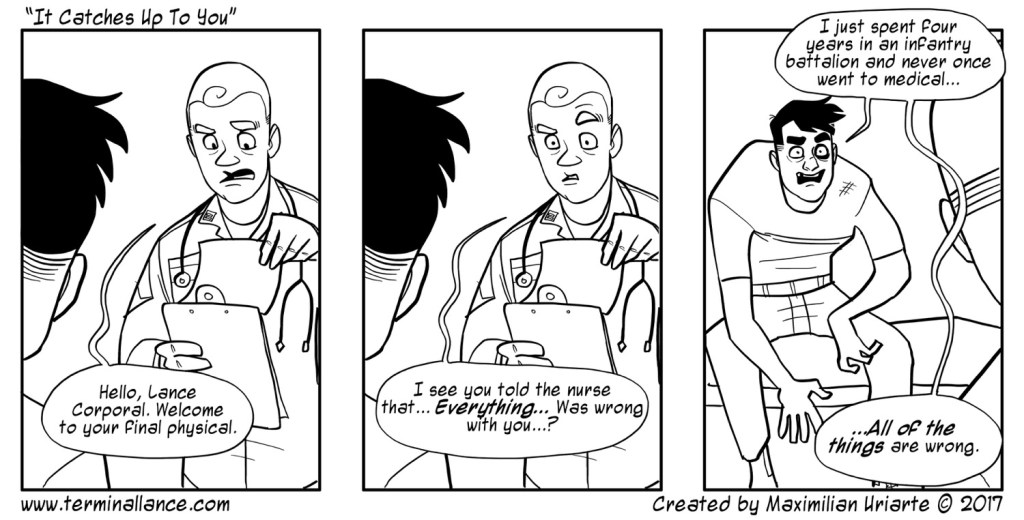
Marines often underreport their injuries while in training and in the operating forces. Only at the end of service does the Marine sometimes report all the injuries he or she has sustained.
Senior leaders understand this. Again, when discussing female Marines, the Marine Corps readily acknowledged the long term implications,
These (physiological) realities are clearly not insurmountable nor are they always manifested during a one-time march under load . . . Rather, the risk lies in the cumulative impact of this physiological disadvantage over the course of regular, recurring and increasingly more challenging dismounted movements (hikes).
Once again, the Marine Corps only looked at women. In its updated physical standards that same year, the Marine Corps chose one-time events to evaluate suitability for certain specialties. Whether a Marine passed these events during their entry-level training determined whether or not they could continue in that specialty. This seems counterintuitive to the above statement acknowledging the “cumulative impact . . . of regular, recurring and increasingly more challenging” tasks.
The Marine Corps did create standards for the operating forces as well. These were designed to ensure Marines remained suited to a specialty throughout their career. However, the Marine Corps acknowledged the difficulty in enforcing these standards. Individual unit commanders would need to implement them. Therefore, enforcement across the force would likely be spotty and irregular. Would commanders really want to remove Marines from their specialties? This would deprive them of Marines in the short term, and potentially damage that Marine’s career in the long term. It’s unclear how well these standards are working in the fleet. If anyone reading this has some insight, please share with me.
These experiences caused me to ask several questions. Has the Marine Corps ever considered instituting a height or weight requirement for certain specialties? If we know the average weight carried by an infantry Marine varies between 80-120 pounds, and we know how detrimental these loads are to a person’s back, spine, hips and knees, why have we not looked at this seriously?
The Royal Marines have, and have instituted requirements and recommendations accordingly. Recommendations for potential Royal Marine recruits included the following:
- Give up smoking or are provided with support to promote smoking cessation.
- Consume at least 1000 mg of calcium a day.
- Consume at least five portions of fruit and vegetables a day.
- Reduce their intake of fizzy drinks, especially cola.
- Improve their aerobic fitness and leg strength.
- Include running and ball sports in their exercise/physical training program.
- The minimum body mass of 65 kg (143 pounds) should continue to be enforced . . . and reconfirmed at the Start of Training.
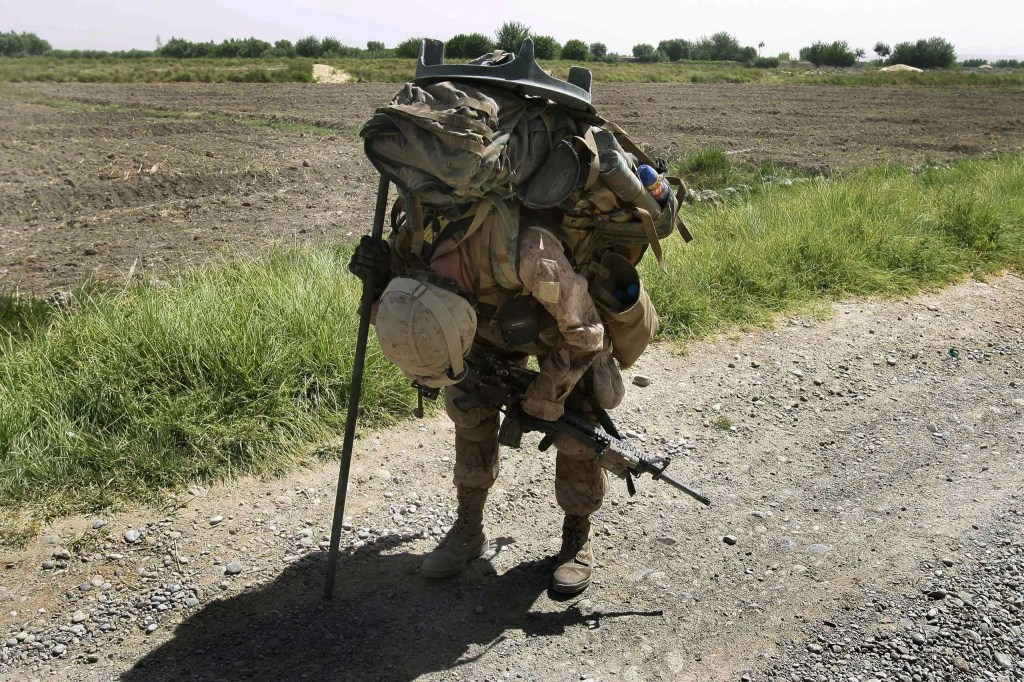
The Marine Corps repeated over and over again that combat effectiveness is the most important thing. It reminded us, “speed itself is a weapon”. Has it ever evaluated the combat effectiveness of its male Marines? Of their (physical) suitability for different jobs? Of their long term injury rates? Of their disabilities after they leave the Marine Corps? Why is a (male) Marine who weighs 141 pounds carrying a pack that weighs 141 pounds? (see below) Is this Marine really combat effective at the end of the hike? Could we, as an institution, not logically look at the loads required in that job and identify a larger Marine to carry that load? Can we not do better as an institution – regardless of gender?
FOOTNOTES
1Pullinger, NC; Pethybridge; RJ & Allsopp, AJ. “Identifying, at Selection, the Physical and Mental Characteristics Associated with Successful Completion of the 30-Week RM Recruit Training Course”: INM Report No. 2001.009, April 2001; Institute of Naval Medicine, Alverstoke, Gosport, Hants PO12 2DL, United Kingdom.
2The average female Marine was five foot four inches tall and weighing 125 pounds. The average man being five foot ten inches tall and weighing 175 pounds. (in 2014)
3Davey, T.; Shaw, A.; Allsopp, AJ; Lanhan-New, SA; Fallowfield, JL., “Surgeon General’s Bone Health Project: Nutritional Influences on Bone Health and Stress Fracture Incidence during Royal Marine Training: Final Report”, INM Report No. 2012.026, June 2012, Institute of Naval Medicine, Alverstoke, Gosport, Hants PO12 2DL, United Kingdom.
 Breaking Into the Brotherhood