Marines who exceed weight and body fat standards are a detriment to and detract from the combat readiness of their unit . . . Simply put, Marines who do not present a suitable military appearance fail to possess the qualities necessary to effectively lead Marines. This is especially true for Marines in a leadership or supervisory role who are required to ensure their subordinates comply with established policies and standards.
Marine Corps Body Composition and Military Appearance Program
There is so much about Marine culture I find hard to explain. I forget how much I take for granted. I forget how much I might have to explain to the uninitiated. We soak it up in our initial training, along with the history and traditions of our Corps. We aren’t fully aware of how we know the things we know. We simply know they are true. We know they are irrefutable fact (at least, within the confines of the Marine Corps, which is all that really matters). We forget that most people outside the Marines would look on our culture as something strange or foreign.
The most basic of these things is how a Marine should look. When you picture a U.S. Marine, you likely picture a man. A well-muscled, squared-jawed, short haircut, stern-looking man.
In much of the Marine Corps, you see that man everywhere. Usually tall, sometimes short. Black, white or brown. You see that vision in women too. It seems like everyone is extremely fit. The Marine Corps makes fitness part of the workday. I had a boss who told me that he considered my day started when I arrived at the gym. Coolest thing ever. Marines trade fitness routines over coffee, push each other on runs at lunch and wake early or stay late to try the latest workout trend.
We have fitness tests twice a year, one to test aerobic fitness and one to test anaerobic fitness. Our fitness test scores contribute to whether or not we get promoted, get to stay in the Marine Corps, get special duty assignments (like Marine Security Guard). They are a symbol of respect in an organization for the strong.
More than once, I saw this play out in my own career. During my time in the Pentagon, I was extremely fit. I was getting up at 4:30 AM to be at the Pentagon gym when it opened at 5:00 AM. I was lifting heavy and running long distances. I was extremely thin. One morning, after a workout that included different types of pull-ups, I happened to be standing in a Pentagon corridor (in uniform) when another Marine approached me. Hands outstretched, the Sergeant Major of the Marine Corps (the senior enlisted Marine in the entire Marine Corps) walked up to me, shook my hand and said, “I knew you had to be a Marine, ma’am. I saw you doing pull-ups in the gym and I knew you had to be a Marine.” He shook my hand, looked at me with the utmost respect, and made my year. The Sergeant Major of the Marine Corps recognized me. He saw me as strong, as worthy, as an example of what it means to be a Marine.
Strength is public, and we want it to be. In 2013, as I was preparing to deploy to Afghanistan, I took a fitness test in front of my entire unit. For weeks, I had worked on my pull-ups. I was determined to reach the maximum number (8 at the time). I had also been running five miles every other day, but had no idea how fast I would run on game day.
Walking up to the pull-up bar, I was nervous. The male Marine recording scores saw me and shouted, “we need a timer!” At the time, women were allowed to choose – they could either do pull-ups or a flexed arm hang (basically, you hang on the bar with your chin above it for certain time). A female Marine behind him had seen me practicing pull-ups, and quickly corrected him. “She doesn’t need a timer, Staff Sergeant, she’s going to do pull-ups!”
No pressure.
Stepping up to the bar, I began. I tried not to think, just kept pulling. I got to eight before I knew it, and still felt strong. So I got to do something I’d only ever seen male Marines do. I got to do one more. Just to show I could. I practically floated off the bar.
The run felt like a breeze after that. I’ve always been one who goes out slow and picks up speed after the turnaround point. The same held true that day. As I closed in on the final mile, I started passing my Marines (male and female). I spoke encouragement as I passed them, proud of myself every step of the way. I would be leading these Marines into Afghanistan in a few short weeks, and had just showed them how capable I was. It was the best physical fitness test (PFT) I completed. Ever.
In my excitement, I shared my scores with my boss. I had no idea that would come back to haunt me in very short order.
In our weekly meeting that morning, he called me out in front of his entire staff. He directed me to tell everyone what my score had been. He did this on purpose. I was a woman, a reservist and a field grade (fairly senior) officer. I was supposed to be weak and slow. But I wasn’t.
Mortified, I shared my scores with the staff. I don’t remember his exact words after that, but it was something like, “that’s what you should all be striving for. She’s setting the example for every single one of you here.”
Fitness isn’t the only thing that’s public. Weight is, too. One might think that with all that working out, keeping weight off would be easy. For a lot of Marines, it is. But not for every Marine.
My first year in the Pentagon, we wore our Charlies (green slacks, tan shirt) every day. This was pretty miserable. Marine uniforms are made to look good, not be comfortable. We sweated through the shirt almost instantly. We wore shirt stays (contraptions intended to induce pain and provoke itching which connected our black socks to our tan shirts, underneath our slacks, just to keep our shirts tucked in and looking sharp). Nothing had any room for movement (or breathing, for that matter). Sitting down after lunch was the most uncomfortable thing one can imagine. But damn it looked good. Professional. Everyone loved seeing Marines working in that uniform.
At the Christmas party that year, I remember the Commandant (our most senior Marine and leader of the Marine Corps) visiting our table with a “present”. He said we would start wearing camouflage uniforms as the regular uniform in the new year. We would only wear Charlies (commonly known as “chucks”) on Fridays. He called it, “gut-check day”. That was code for, “you’re not allowed to get fat, just because you’re wearing a uniform four days a week with a little more room in it”.
It worked. Knowing we had to wear Charlies every Friday made us think before we ate. It made us think before someone brought “fat pills” (aka, donuts) to the office.
Weigh-ins happened twice a year, just like the fitness tests. Weigh-ins were also public, just like the fitness tests. I hated the weigh-in. I always felt naked standing in line, waiting my turn, clad in just a green t-shirt, green shorts and (white) socks. I hated that they had to be white socks. They didn’t really. The regulation only said, “socks”, but the grief I’d get from the Marine conducting the weigh-ins wasn’t worth it. So I had a pair of white socks for one exclusive purpose – just for the weigh-in.
The only authorized uniform for the weigh-in . . . is the Marine Corps approved green-on-green T-shirt, shorts and socks. No other uniform or clothing garment is permitted. Shoes will be removed prior to evaluation.
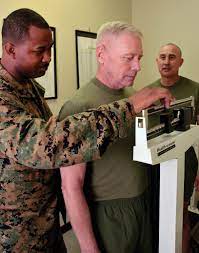
Marines struggled with their weight for a variety of reasons. Some simply had too much muscle. Some simply floated too close to the restriction, and found themselves needing to drop “a few pounds” so they could “make weight” every six months. The days and weeks preceding a weigh-in involved some level of stress for a great many Marines. It also involved a great many conversations about dropping weight.
It was such a normal conversation. I was so used to this conversation, repeating itself twice a year. For many years, it didn’t register in my mind this was not a conversation anyone outside the military would consider normal.
The details changed. The methods got updated. But the substance remained the same. Marines talking about the weigh-in, dreading it, putting it off as long as possible. Marines exchanging strategies to drop five, ten, fifteen pounds in the days or weeks prior to the weigh-in.
I know Marines who wore garbage bags while they ran, and who would weigh themselves afterwards to see how much weight they’d lost. If it wasn’t enough, they might go out running again, or they might sit in the sauna (with the garbage bag still on).
I know Marines who used diuretics, diet pills, special shakes, liquid diets and other things all in an effort to drop weight – fast.
I know female Marines who would stop lifting weights weeks in advance to drop the weight they had acquired by building muscle. They dropped the muscle they had built to do pull-ups and to hike long distances. After the weigh-in, they would put that muscle right back on. They needed it.
I know Marines who stopped eating prior to the weigh in. One friend told me he hadn’t eaten in five days. More commonly, Marines would not eat that morning until they had completed their weigh-in. Then they have a massive breakfast afterwards. This was so common. I remember engaging in this “celebratory” breakfast. I remember being so happy, that I got to join in this tradition, that by being thin enough or fit enough (hopefully both), I had proven I was “good enough” to be a Marine for another six months.
When I first came in the Marine Corps, the twice annual weigh-in took place the same day as the twice annual fitness test. The Marine Corps stopped this several years ago. In the latest regulations, the Marine Corps simply states the weigh-in does not have to take place on the same day as a fitness test. It does this to prevent Marines from being too weak (from lack of food) to perform to a maximum level on the fitness test.
None of these Marines was fat. The discussions were usually about 3-5 pounds. Some of the male Marines would need to lose 10-15 pounds. It didn’t matter. Whether it was 1 pound over or 50 pounds over, the consequences were the same.
Not every Marine struggles with the weigh-in. I never really worried about my weight. I was lucky. The only time I worried about putting on weight was the year I underwent two foot surgeries to repair torn tendons and remove inflamed nerves. I spent a total of sixteen weeks on crutches in a period of six months. I could not work out at all. But I knew I needed to fit into my uniform no matter what. We still had “gut-check Fridays” and undergoing surgery was no excuse to be “fat”. I knew I needed to look respectable (thin) in that uniform no matter what. I drank green smoothies, snacked on raw veggies, swore off bread and ate smaller portions for two years. All in an effort to ensure I showed up every day looking like a Marine was expected to look.
There were real consequences to failing the weigh-in.
- Enlisted Marines. Enlisted Marines are placed in a promotion restriction status while assigned to the Body Composition Program.
- Officers. Commanders may request promotions be delayed for those officers who are deemed not physically qualified for promotion.
- Retention. Marines who do not meet established weight and body composition standards or fail to present a suitable military appearance are not eligible for reenlistment or voluntary extension.
- Special Schools/Special Duty Assignment (SDA). Marines who do not meet established weight and body composition standards or fail to present a suitable military appearance may be ineligible for selection to special schools and assignment to specific SDA billets . . . This provision also applies to
selection for and attendance at officer and enlisted resident professional military education (PME).
The unspoken consequences felt just as real. That respect I earned in the Pentagon gym and during that one fitness test could have evaporated had I been out of weight standards. A Marine who fails the weight standard is “fat”, “nasty”, “lazy”.
When you first become a Marine, it’s kind of like the mafia. You’re in for life.
But when you fail to make weight, you are cast to the far corners of this exclusive club. Marines will go to extreme measures to make weight. You become a pariah, someone no one else wants to be around. Until you lose the weight, then you may be accepted again. By then, it can be too late to save a Marine’s career.
Some articles talk about the prevalence of eating disorders in the Marine Corps. Others claim there really is no problem. It all depends on the definition of an eating disorder.
The 2019 version of the Marine Corps Body Composition and Military Appearance Program regulation is 57 pages long. It includes direction on how to conduct a weigh-in, how and when to assign Marines to be monitored for body composition and the repercussions should a Marine not maintain weight standards.
When we visited Canada in 2014, their officers told me and my female colleague they did not have weigh-ins.
Even I, who had never really struggled with her weight, felt the relief flood my body. No weigh-ins?! What kind of crazy, amazing world were they talking about? No more, “you’re fat so your career is over”? No more, “you’re lazy and weak so you can’t be a Marine anymore”? No more, “you don’t look like a broad-shouldered, small-torso leader so you can’t be a commanding officer”?
There are real reasons to have weight standards. It’s simply that a lot of stress and a lot of unhealthy thinking (and actions) often accompany those weight standards. And in an organization that prides itself on performance, it also spends a lot of time worried about what people look like. Sometimes, that can get in the way of performance. Remember, women who were out of weight standards were nearly twice as likely to complete the 20 kilometer hike (at infantry training school) as women within weight standards. The Marine Corps has updated its weight standards since then.
In 2016, a female captain stood in a town hall with the Commandant and asked, the Marine Corps is asking women to do pull-ups. That would mean adding muscle (weight) to their bodies. Was the Marine Corps going to allow that? In the most recent update to weight restrictions, the Marine Corps has allowed women a few more pounds (5-7). It also updated (increased) scoring for both fitness tests. There still remains a difference between men’s weight standards and women’s weight standards.
The culture of thinness and fitness remains strong in the Marine Corps. I had always taken for granted this was the only way to maintain a ready force. Seeing the officers from Canada, I saw a different path. Perhaps there is a way to ensure a Marine’s health and well-being, to ensure their readiness for combat without forcing them to resort to extreme measures. Perhaps we need to continuing exploring new ways, to enable them to do all the things we ask of them.
 Breaking Into the Brotherhood