This post may seem a bit out of place chronologically. But I had the opportunity to visit the Marine Corps’ infantry training course recently, and I wanted to share the experience with you. Next post, we will resume our journey at the beginning.
The Marine Corps that I know doesn’t just invite people to its training courses for a behind-the-scenes look. When I received the invitation to visit the infantry training course at Camp Pendleton, California, I was over the moon.
It all started with a history interview. I had been speaking with a staff sergeant (SSgt) who had participated in the research back in 2014-2015. He was now an instructor at Infantry Training Battalion – West (ITB-West). We talked about many things, but especially the initial training for enlisted infantry Marines.1 At the end of our conversation, he said, “Ma’am, you need to come out and see what we’re doing here”.
ITB-West was running a pilot course to create a different kind of infantry Marine. The Infantry Marine Course (IMC) would be sending a more capable, thoughtful young Marine to the operating forces. These innovators believe that “in the information age (an infantry Marine) needs to be a critical thinker; needs to be resilient; needs to be confident in the(ir) physical (capability) and needs to be confident in being alone (in the battle space)”. They made it their mission for young Marines to be able to do all these things when they arrived at their first unit.2
This represents a dramatic shift from previous views of entry-level infantry training. Prior to this, it was all about the basics. A Marine’s first unit would teach them everything else they needed to know, and would ensure they completed the required physical training of the infantry. The Marine Corps “long relied heavily on the fundamental assumption that simply because a Marine . . . is a male . . . he should be capable of performing all of the physical tasks associated with the regular duties”.3
This approach resulted in a 95% graduation rate from ITB. If they needed to be “recycled” to the next class (for various reasons), they would be until they graduated. In those 5% of cases, they either performed so poorly or got injured and had to be reassigned to a different specialty. This meant that the Marine Corps could fill its requisite number of infantry battalions each year, but there were no real standards. Marines were shuffled on to their first units not always ready or prepared for the operating forces.
According to senior Marine leaders, as much as 10% of the Marines (at the time) who graduated from entry-level training were not capable of meeting the physical requirements in their units. This resulted in “wastage . . . due to Marines being physically incapable of meeting the demands of service in those occupations”.4 Those Marines unable to meet requirements either needed assistance from their fellow Marines, eventually may have been reassigned to a different specialty or struggled for the duration of their enlistment.
It’s taken several years, but the Marine Corps is making changes. Chief Warrant 3 AJ Pasciuti and his staff of senior enlisted Marines are leading the way to transform the old industrial model into a 21st century “student-centered” course using adult learning theory.5 The new course is twelve weeks long, while the legacy course requires only eight weeks. It includes far more hiking, patrolling and learning different weapons systems. It teaches Marines how to understand, interpret and follow a five paragraph order (the basis for all military operations), a warning order and a fragmentary order.
It includes a week-long capstone event, in which the Marines put together everything they’ve learned. This takes place entirely in the field (that means – no showers at night or comfortable racks to return to). The pace and level of learning are intense, according to the student Marines I met. Usually young enlisted Marines are nervous around leadership, focused on doing what they are told and avoiding trouble. These students – mostly 18 or 19 years old – were confident, professional, comfortable, intelligent and all smiles on the third day of their capstone event.
The instructors purposefully treat the students like adults, with a respectful and more collegial attitude than a superior-subordinate attitude. I heard this several times, from various individuals, over the course of my trip. Why is this important? Up to this point, the Marine Corps has viewed the enlisted infantry Marine as a tool to be employed, a subordinate to be told what to do. Less viewed as a thinking individuals, they were trained to do one thing – to fight.
The cartoon below demonstrates this sentiment remains a common perception.6 Terminal Lance is a popular cartoon with Marines across the Marine Corps. It represents life as your average “grunt” (infantry Marine). Like so much humor, it’s funny because it’s true.
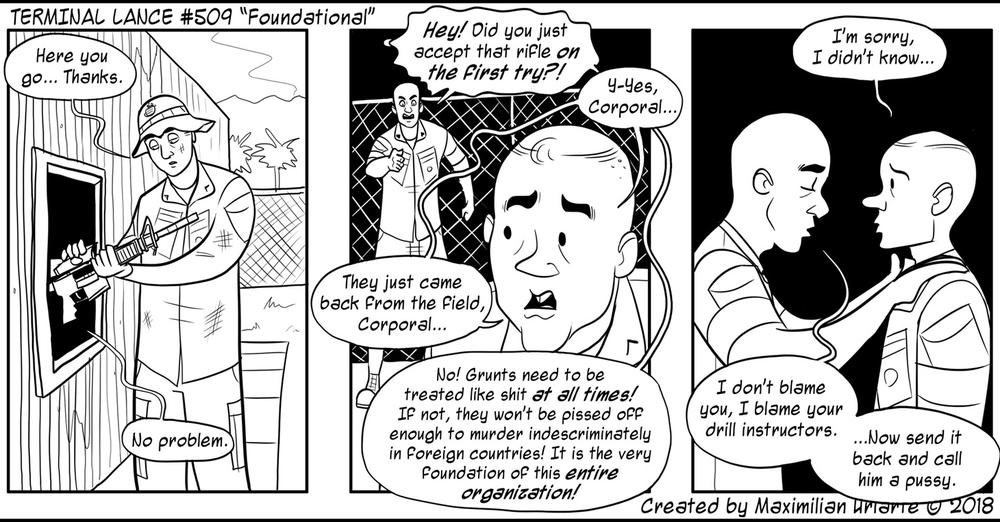
A lance corporal is the third most junior rank in the Marine Corps. Often derided as an irresponsible individual, constantly getting in trouble and doing unintelligent things, the lance corporal has been used over and over again as the example of what not to do in the Marine Corps – for decades. Chief Warrant Officer 3 Pasciuti wants to change that. He says,
Enlisted are trained; officers are educated. Enlisted are trained to do something; officers are educated as to the why and the how. What if we tried to change the dynamic of what we think of a lance corporal? Larger level decisions are going to have to happen at lower levels in the future. I don’t know what the future battlefield will look like, but I know it will be diverse, confusing and dynamic . . . we are educating these Marines so that when they become a sergeant, they can make lieutenant level decisions, allowing the lieutenant of the future to make captain level decisions. We are working to educate the lowest level of the populace so that we can collectively raise the intellectual level across the board.
CWO3 AJ Pasciuti in discussion with the author, May 2021
For those who may be wondering, what does this have to do with gender integration? A lot.
First, one of the often overlooked benefits of gender integration is the institutional light that it shines on previously all-male areas. For example, it was common knowledge in the infantry community that there were no real standards at entry-level infantry training.7 However, the system had continued much as it had since the Vietnam era, until the Secretary of Defense opened all specialties to women. As the first women entered infantry school, the Marine Corps took a hard look at its training. In its attempt to gather quantifiable data about how the women were doing, it realized that there were precious few data points to collect.
This forced a conversation within the infantry community about standards. If the only requirement had been to be male, what kind of Marine were they providing to the operating forces? What kind of Marine did they need or want to provide? It would take five more years to answer this question. The Marines at ITB-West (and ITB-East) are experimenting to see how best to support the force of the future.
Second, two women graduated with this class on September 3rd, 2021. And according to their instructor, they were fully integrated. They lived in the same squad bays as the male students. They shared the same bathrooms (but not showers). They carried the same packs and weapon systems, and were given leadership responsibilities. They were also graded on the same fitness scoring table (the male standard). This surprised me the most.
In the Marine Corps, “gender-normed” fitness tests still exist. That means that men and women perform the same exercises, but are graded on a different standard. For example, the highest scoring three mile run time for men is eighteen minutes; for women, it is twenty-one minutes. Men receive 100 points for an eighteen minute run; women receive 100 points for a twenty-one minute run. It is the same across all fitness events.
In 2015, I advocated for a “gender-neutral” standard in these fitness tests – at least in the infantry. We knew from our experience with the Israelis and the Canadians that women would be expected to meet the male standard – whether or not that was the official standard. That was just how it worked. If they wanted the same level of respect, they had to do the same things.
I argued that if the male standard was going to be the standard (in the minds of the Marines) then that should be the official standard. The Marine Corps should tell young women entering the Marine Corps what the standard would really be – not some gender-normed standard for which they would feel resentment their entire careers. Again, this would only have applied to the infantry. Regardless, I lost the argument.
But five years later, in this small corner the Marine Corps, the instructors at ITB-West are simply doing it. In their internal tracking systems, they have set a gender-neutral standard. They measured the female students against the male standard.
How did the women do? One ran a first class; the other ran a third class. That means they both passed and will (did) graduate. But a first class fitness test puts one in a different category. She’s competing with her male counterparts, and holding her own.
When I expressed my surprise (and happiness), one of the instructors said, “we have to stop making a big deal out of everything”. One of the others said, we need to “just treat ’em like Marines”.
Of course. It really is that simple.
What does the Commandant think of the new Infantry Marine Course (IMC)? The Marines with whom I spoke were not sure. Believe it or not, there are many layers between the instructors and the Commandant. It can be difficult to know what the most senior Marine thinks about your particular initiative.
But this Commandant has been a visionary and an innovator from the start. So it was no surprise to me to hear his perspective,
There’s a new infantry pipeline . . . we’ve lengthened it; broadened it. Why? Because we think we have to deliver a different Marine to their first unit. Marines with multiple skills – ones that can . . . visualize the battlefield long before they get there.
Gen David H. Berger, CMC Speaks at the MCA National Breakfast Sept 20218
Based on General Berger’s thoughts, my hope is that some version of this pilot course will become the new standard. The students are of a different caliber than what one would usually expect at entry-level training. All the Marines – the staff, instructors and students – impressed me. Five years after integrating women, the normalization process is already taking place. The assumption is no longer that being a male is sufficient. Regardless of gender, one must simply be able to do the job.
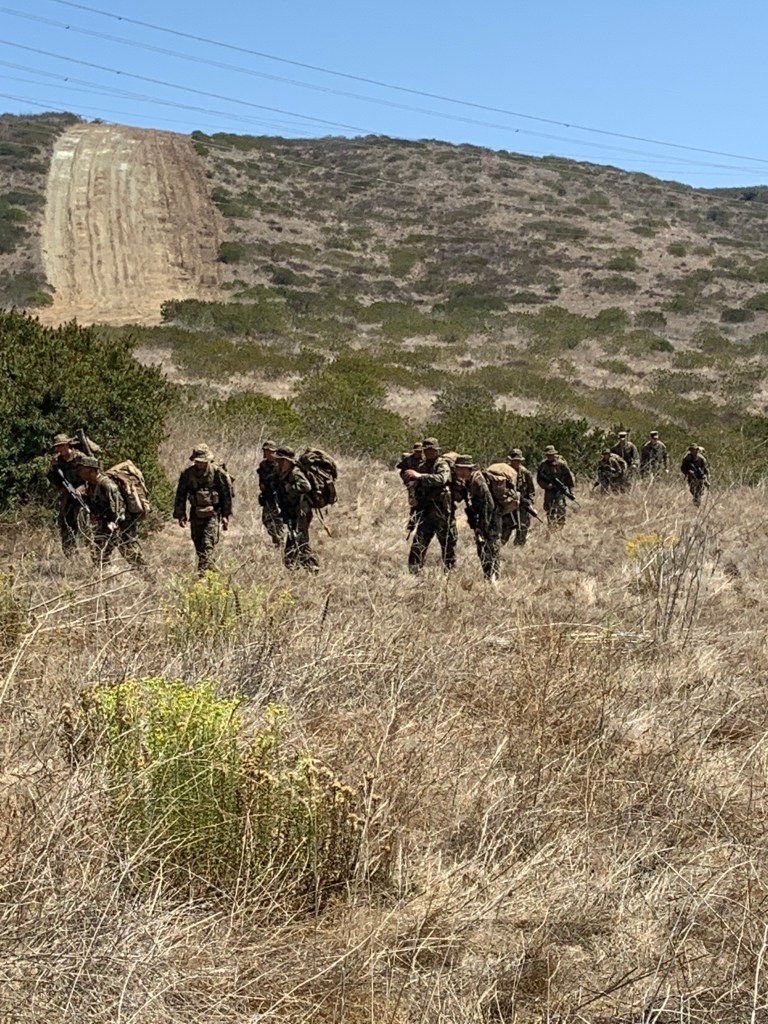
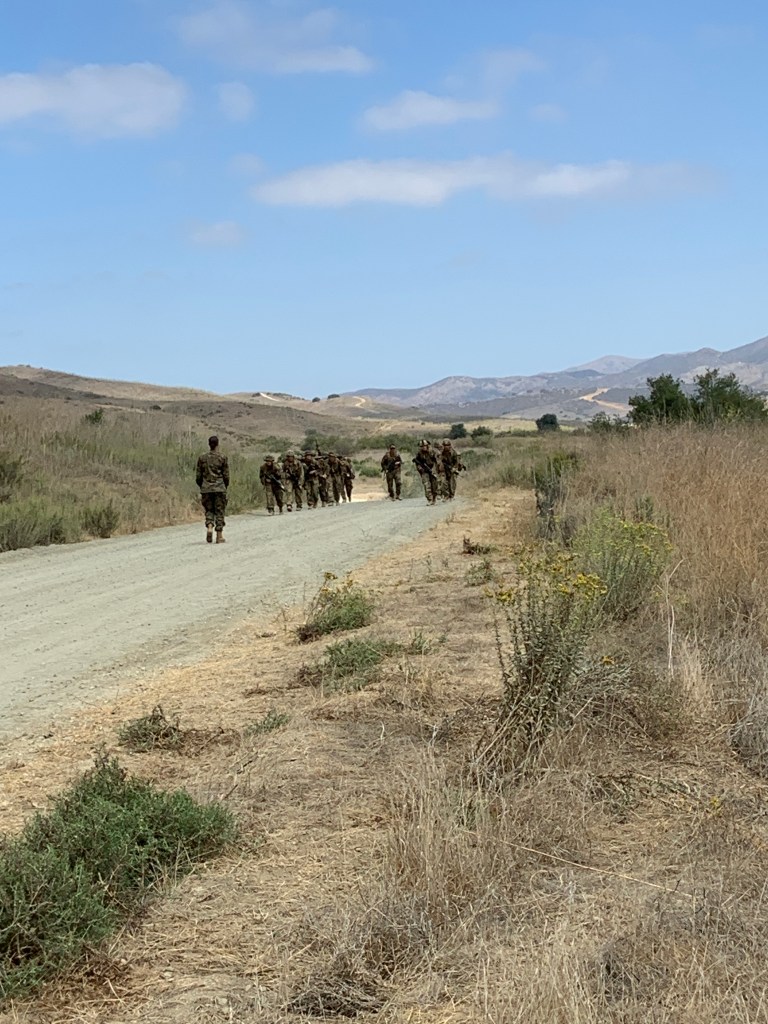
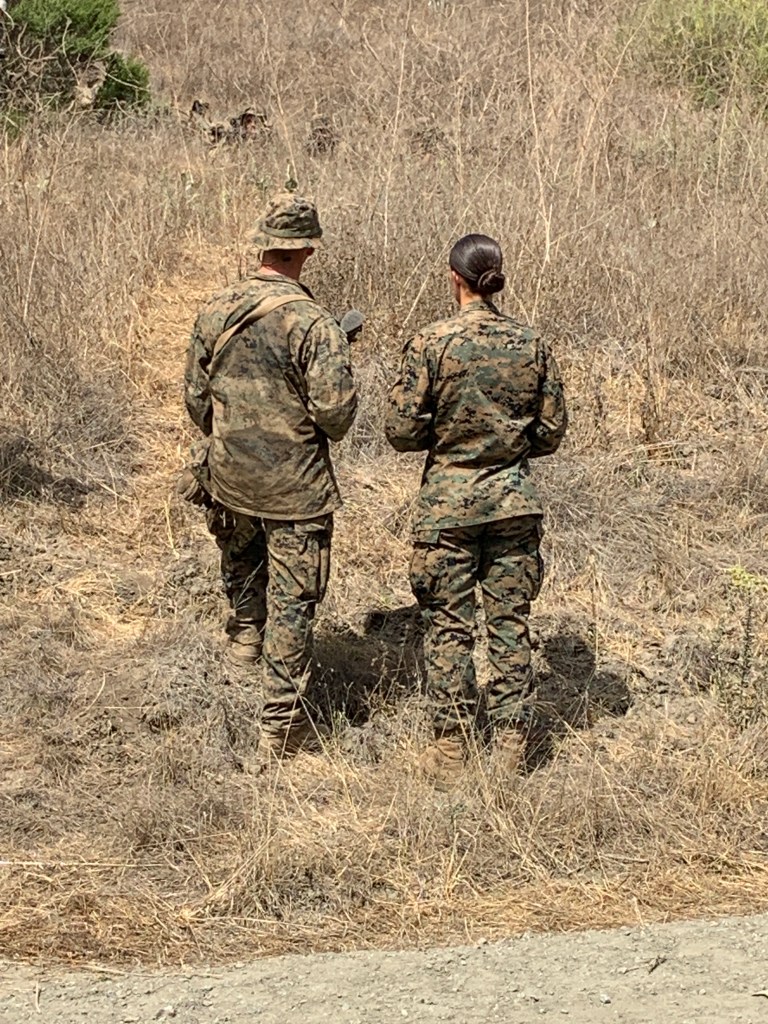
Female instructor giving feedback to a male student 
Marines disassemble and reassemble a machine gun 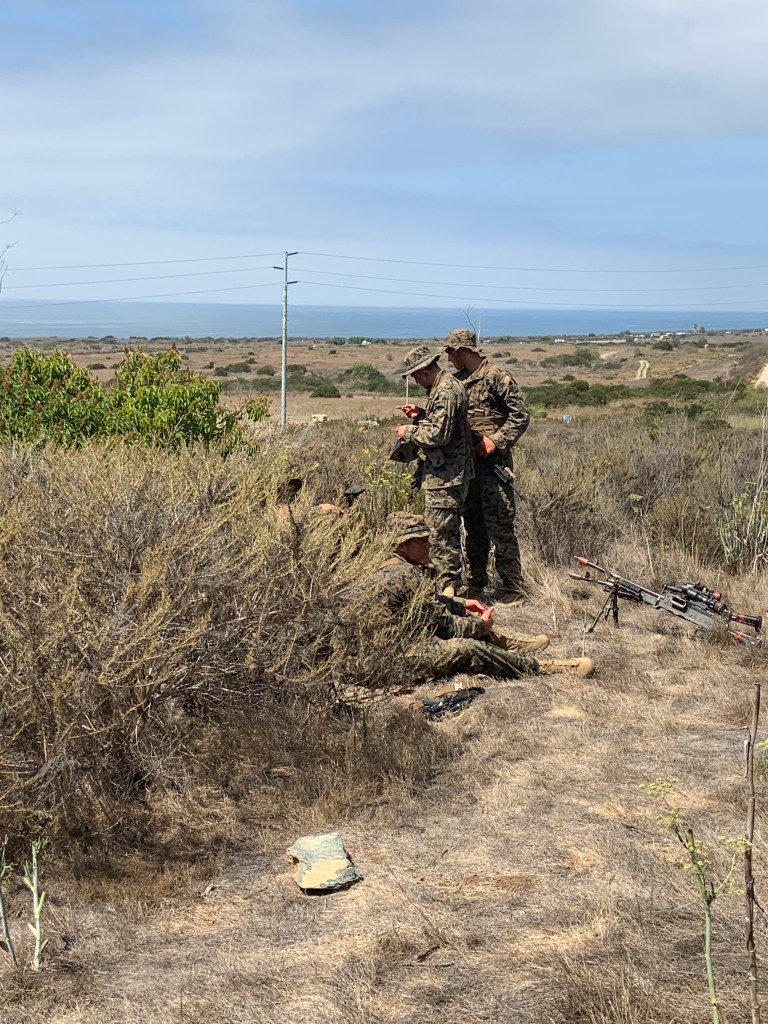
Marines engage in ever necessary task of changing socks
REFERENCES
1Officers attend the Infantry Officers Course (IOC), held in Quantico, Virginia. For enlisted Marines, there are two entry-level training schools – one on the east coast (Camp Lejeune, North Carolina) and one on the west coast (Camp Pendleton, California).
2Burkhart, Blake, oral history interview with author, 30 August 2021, Camp Pendleton, California. Additionally, ITB-East, in Camp Lejeune, North Carolina is running its own pilot program. I do not know the specifics on what is similar and what is different, but both infantry schools are changing the course.
3Smith Jr., George W., Memorandum for the Commandant: United States Marine Corps Assessment of Women in Service Assignments, Headquarters, U.S. Marine Corps, 18 August 2015.
4Ibid.
5Burkhart, Blake, oral history interview with author, 30 August 2021, Camp Pendleton, California.
6“The idea behind Terminal Lance is to poke fun at the Marine Corps with an emphasis on the grunt Lance Corporal’s point of view”. This hugely popular cartoon elicits thousands of responses on social media and has spawned a book, The White Donkey.
7History interviews and discussions with various officers and senior enlisted 2014-2021.
8Gen David H. Berger, CMC Speaks at the MCA National Breakfast Sept 2021.
 Breaking Into the Brotherhood
First, thank you for your business card with the link to this blog.
The quote with CWO3 Aj Pasciuti in the middle of the page in which I will paste a snippet here for the people reading the comments: “….What if we tried to change the dynamic of what we think of a lance corporal? Larger level decisions are going to have to happen at lower levels in the future…we are educating these Marines so that when they become a sergeant, they can make lieutenant level decisions, allowing the lieutenant of the future to make captain level decisions. We are working to educate the lowest level of the populace so that we can collectively raise the intellectual level across the board…” really struck out to me and it’s fascinating that I am reading about this concept in 2022 on your blog and you heard it from Aj in 2021.
Let me provide some background behind why this is so amazing for me to read and I’m glad someone in the Marine Corps is thinking about this.
In 2013, a former submarine commander by the name of David Marquet, published his book called “Turn The Ship Around: A True Story of Turning Followers Into Leaders”. The book revolves around the concept of “Leadership should mean giving control rather than taking control and creating leaders rather than forging followers.”
In the early 2000’s he conducted a leadership experiment on his boat (submariners use the term “boat” to reference a submarine), the USS Santa Fe. The experiment worked. Some boat captains on the waterfront adopted it but some did not because they were “old school” and were stuck in their ways and wanted to retain control. The leadership model requires a boat CO to “give up control” which many didn’t want to do. Fortunately for me, it was 2006 and I was on a boat on the waterfront in which the CO adopted this model (which was still experimental at the time I believe). As a young division officer, I was on the receiving end of this experimental model. Later on, from 2014-2016, I had an opportunity to use/test out this model with a small team of about 12 sailors since now I was the one in a leadership position, not of a ship but instead a small tactical level unit/team deployed underway and unafraid. Small teams are nice to do leadership labs with I thought, since the risk was small if things went south (depending on the scenario of course). The result was as expected: everyone achieved the path of greatness.
The best way to explain this model without diving deep into the details of the book is that the CO would refrain from giving orders (with the exception of weapons release because that involves killing people) and instead they would give up control. Orders were replaced with intent. Instead of giving instructions, if you want your people to use their brain and think, don’t give instructions, give intent. CO gives intent to them, they give intent to the CO. At first, while it might seem like a small nuanced change of language, it actually is immensely powerful because the psychological ownership now shifts to them, the people. They have to discover the answer, otherwise the CO will always be the answer man. In discovering the answer, they start to think deeper into the problem set and come up with a plan on their own vice wait for someone to tell them what to do. Sound familiar ya? That’s exactly what Aj and his team are trying to do at ITB-West from what I am reading in your blog post.
Note of caution: Many glance over some key concepts when trying to implement this to their own teams and the model will fail. The concept of giving away control hinges heavily on two pillars. One pillar is the technical competence (represented by “Is it safe?” or “I know my equipment can do this or needs this for it to work”, in the context of battlefield operations or tactical decision making), in which it appears ITB-West is doing very well……. and the other is organizational clarity (“Is it the right thing to do?”, typically set by higher authority or provided by other means such as observing the environment/pushing information down to the lowest levels), which via 5 paragraph order and other pin pointed guidance accomplishes this. Over time, the officers under the CO start thinking like the CO. The enlisted under the officers start thinking like the officers. After a year or more into the experiment, everyone onboard was thinking, active, passionate, creative, proactive and taking initiative. [Move the authority to where the information is], <<<Key concept<<< which is where the junior officers and enlisted are. Old models have the guys sleeping in the foxholes, the guys in the engine room, report information all the way up to the CO and the CO then makes a decision/gives an order and this new model shakes it all up.
David Marquet has a 10 minute TED Talk about all of this, with animation at the link below and he wraps it up by translating this model to the business world. The model ends up creating an environment such that the people in the cubicle farm trenches are making decisions as if the CEO was standing right behind them. And if it's not the same decision, it's actually a better decision because they have the information right there. And not only will the company get better speed of execution because of the lack of delay going back and forth between team and CEO, those people now feel like they matter because they are thinking and actively engaged. The CEO has created an environment for thinking.
Old Model: Take Control and Attract Followers. New Model: Give Control and Create Leaders.
The book gets into all the crazy details of this model if you are interested in reading about it after you're done with school and all that.
LikeLike
This is so great, for so many reasons. Thank you for sharing that story. The Marine Corps has long embraced the concept of “Commander’s Intent”, to include those two important caveats you identify. It was stressed to me as a young officer (in the early 2000s) and we may (as an organization) drifted from that a bit. It’s time to come back that way, and to teach our youngest Marines and sailors to operate with intent rather than explicit orders, for all the reasons you state.
LikeLike
Pingback: Australia: Women in Combat | Breaking Into the Brotherhood