I don’t think that we would have gotten the results we did if we didn’t have the leadership we had.
Chief Warrant Officer 2 Billy Shinault, January 2021
This post will be the first in a series which looks at the women’s integration into the enlisted infantry course. Unlike the officer’s course, I have numerous official documents, background stories and personal accounts. I’m excited to put this story together for you, so come along and enjoy.
My interest in the enlisted infantry course began in the summer of 2014, for a reason unrelated to the infantry. Female Marines entered artillery and tank schools for the first time ever that summer. Women were going through these schools in preparation for the experiment (to be conducted in 2015).
No surprise to many, the young women faced challenges in both schools. Though they were Army-run, there were Marines on staff specifically for the Marine students. Some of the instructors and staff – at both schools – were making the women’s lives difficult. We often found out too late to be able to do much about it.
These incidents sparked my interest in the infantry course, because they made me aware of the deafening silence coming from the Infantry Training Battalion (ITB)1. Women had been going through the enlisted course for over a year, and yet we’d heard almost nothing. Why?
Let’s backtrack a year or so. In mid-2013, (then) Lieutenant Colonel David Wallis learned that the Marine Corps wanted to send women through the enlisted infantry course. Women had been attempting the officer course since 2012 with no success. The Marine Corps decided to open the enlisted course to women to see if any could make it through.
The purpose was to gather data on the women’s performance. Volunteers would attempt the eight-week course, but they would not become infantry Marines. Their data would be collected, and put together as part of the larger documentation sent to the Commandant when all research was complete. They would then go to their actual training course, to become the drivers, mechanics, administrators or whatever Military Occupational Specialty (MOS – basically your job) the Marine Corps had given them.
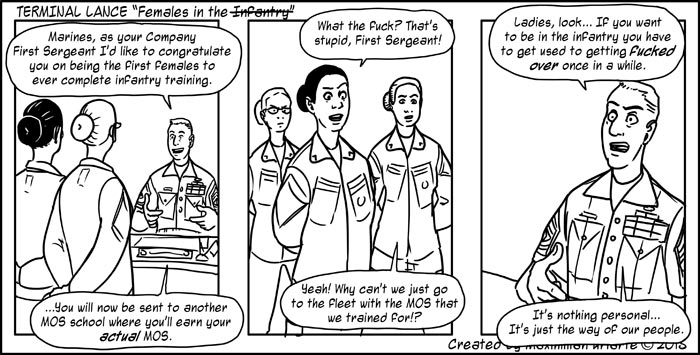
The commanding officer (CO) sets the leadership tone for a unit. The CO must understand the Marines before he or she hopes to lead them. The CO must also understand those things most important to the Marine Corps.
As the CO at ITB-East, it would be Lieutenant Colonel David Wallis’ responsibility to integrate women for the first time. He faced a mammoth task, and he knew it.
Did the Marine Corps know it? Because there was (is) also a major difference between the enlisted and officer courses – the graduation rate. Between 2012-2015, the graduation rates were as follows:
- Officer Course (for males): 67%
- Enlisted Course (for males): 95%2
We have a saying in the Marine Corps: “attrition is the mission”.3 Though not usually applied to training courses, this is the phrase that comes to mind when I think of the infantry officer’s course (IOC). They purposefully pushed lieutenants to their limits – to prove they had what it took to become an infantry officer. So when the Marine Corps sent women through the course to “see if they could make it”, that meant something, and was easily executable.
ITB was (is) not a screening mechanism. The primary purpose of ITB was (is) to train. With a 95% graduation rate, they were not screening Marines out. They were training them to a basic level and then sending them to their first units for the remainder of their training and physical preparedness. So when the Marine Corps sent women through the course to “see if they could make it”, they were missing something. And it was not easily executable.
Dave Wallis (and a host of others who supported him) understood this clearly.
First, he knew the Marine Corps would need data. The Defense Secretary required it.4 Yet there were only two graduation requirements at ITB5, since the assumption had always been that if a Marine was a male then he was capable of completing the course.
Second, he knew he would have to set conditions to ensure “transparency and equality” in training. He would have to ensure the female volunteers would have the same opportunity to succeed as the male students.
Third, he knew his male instructors needed to feel confident in the women’s training. He had combat veterans as instructor – Marines with recent deployments to Iraq and Afghanistan. Many of these Marines had lost comrades on those deployments. They took the ITB training very seriously.
All the ITB Marines with whom I spoke believed the decision to integrate women to be a political one. Meaning, they believed that regardless of what the research showed, women would be integrated. They wanted to ensure women were trained to the same standard as the men.
To be successful, Wallis knew that he had to address all of the above. He would do so with minimal guidance or financial support from the Marine Corps.
He had “a million ideas”. Over the course of several months in 2013 he would put many of them in place.
After speaking with many of his Marines and with him, I realized something. That deafening silence coming out of ITB? That was the leadership of Lieutenant Colonel Wallis and the Marines around him.
Over the next several posts, I will detail the plan, execution and results of the work he and others put into making women’s integration at ITB a success.
REFERENCES
1There are two enlisted training battalions. On the east coast, Infantry Training Battalion – East (ITB-East) at Camp Lejeune, North Carolina and on the west coast, ITB-West at Camp Pendleton, California.
2 “Marine Corps Force Integration Plan Line of Effort 2 (Expanded ELT Research Studies): Research Assessment & Findings Report”, Training and Education Command, U.S. Marine Corps, 2 Jul 2015.
3This saying usually applies to how many Marines the Marine Corps keeps (or rather, doesn’t keep) after their first four years. The Marine Corps has always prided itself on being a young force, typically returning 75% of Marines back to the civilian world after their initial four year contracts. If you re-enlist in the Marine Corps, you are a select few. from “Marines Will Overhaul Recruiting, Retention in Shift Away from a Young, ‘Replaceable’ Force, General Says“; Lamothe, Dan; The Washington Post, 3 Nov 2021.
4 In the January 2013 memo, the Defense Secretary required that any requests to keep a job (such as infantry) closed to women “must be narrowly tailored, and based on rigorous analysis of factual data regarding the knowledge, skills and abilities needed for the position.” from Elimination of 1994 Direct Ground Combat Definition and Assignment Rule: Memorandum for Secretaries of the Military Departments, Acting Undersecretary of Defense for Personnel and Readiness, Chiefs of Military Service, 24 January 2013.
5First, students must pass the final Physical Fitness Test (PFT) and final Combat Fitness Test (CFT) and second, students must complete the final 20 kilometer hike in under five hours. from “Assessment of Enlisted Female Marine Volunteers at Infantry Training Battalion (ITB)”, Research Protocol and Final Report; Pappa, Leon; Training and Education Command; U.S. Marine Corps; Jul 2015.
 Breaking Into the Brotherhood
Pingback: Standards, Part 1 (Enlisted Infantry Training) – Breaking Into the Brotherhood