There’s a myth that Marine training turns baby-faced recruits into bloodthirsty killers. Trust me, the Marine Corps is not that efficient. What it does teach, however, is a lot more useful. The Marine Corps teaches you how to be miserable.
Steven Pressfield in The War of Art
The hill seemed interminably long. Just as I thought we’d reached the crest, we would turn and there would be more hill. I was bent over, sweat running in my eyes and questioning my life choices. As I leaned over further, in an attempt to shift so the weight sat on my hips instead of pulled from my shoulders, I noticed a Marine next to me who had no business being there. Outside the main column, the Marine was slowly falling behind. As I continued, this Marine fell further behind, little by little, until no longer in sight. I concentrated on myself and kept going.
My sole thought, “At least it’s not me”.
Halfway up that hill, somehow, I was holding my own. This hike didn’t seem nearly as miserable or difficult as the hikes I had completed at The Basic School (TBS), or even Officer Candidates School (OCS). I wasn’t sure why. Perhaps I had genuinely improved (unlikely). Perhaps we were carrying less weight (somewhat more likely). Perhaps we weren’t going as fast (entirely possible). Perhaps I felt less fear. Having completed numerous hikes during my entry-level training, I knew how to throw my legs out in front of me, taking longer strides. I knew how to jog to keep up, if I needed to. I also knew that keeping up was THE MOST IMPORTANT THING. I might be breathing hard, sweating profusely and might collapse at the end. I might even injure myself, but that was ok. Hurting myself – if it meant keeping up – was completely acceptable as long as I held my place in the column.
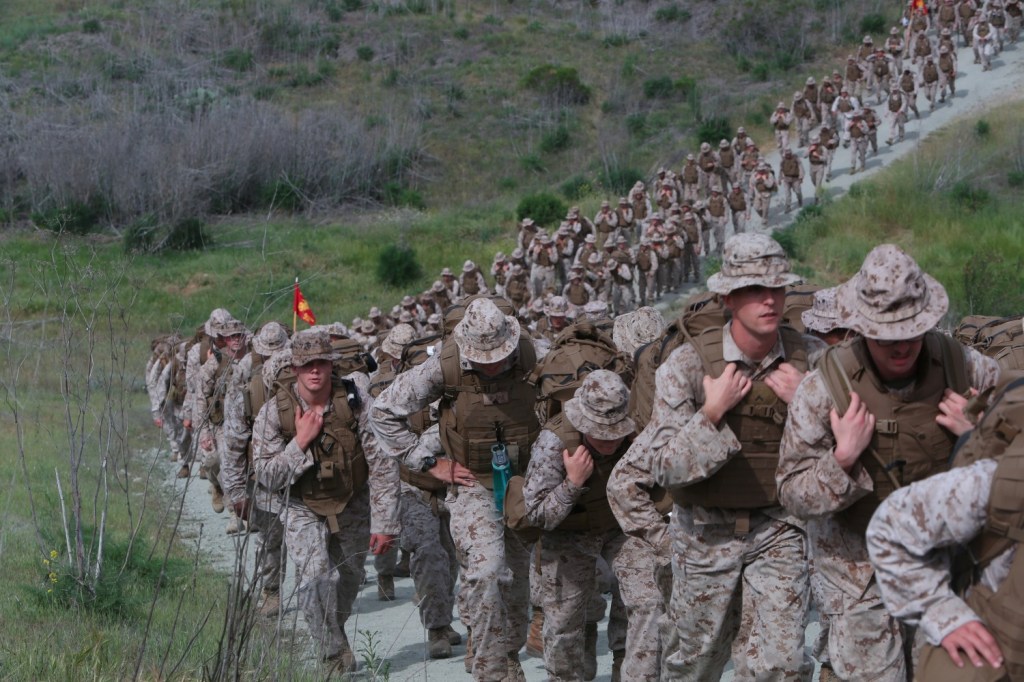
Hiking under load1 is such an integral part of the Marine experience that it never occurred to me to ask why we did it. For non-infantry Marines, it all seemed like part of the “harassment package”.2 We hiked at every point of entry-level training. For infantry Marines, was simply everyday life. Remember enlisted entry-level training standards? There were only three physical requirements to pass the course – the PFT, CFT and the 20 kilometer hike.
Upon graduating from school and entering their first battalions, infantry Marines continued to hike as a regular part of their training. I assumed there must be a combat necessity. It wasn’t until 2015 that I first questioned this. A group from the Defense Advisory Committee on Women in the Service (DACOWITS) visited the Ground Combat Element Integrated Task Force (GCEITF) while the research was going on. While there, they queried the research requirement to conduct a seven-kilometer hike, carrying loads ranging 80-125 pounds. “Why do you have to walk? ”, they asked. With helicopters and motorized vehicles readily available for transport, the notion seemed (to them) simultaneously superfluous and inefficient. Implied was a larger critique of the Marine Corp’s seemingly relentless devotion to hiking with weight.
For the Marine Corps, hiking with weight was not merely an outdated mode of transportation. Being able to operate on foot, with weapon, ammunition, food, water, personal protective gear and whatever else the mission demanded, remained a central tenet of the Marine Corps’ expeditionary operational concept. As one battalion commander returning from Afghanistan said, “It’s (hiking with weight) not a design flaw; it’s a feature”.
History offers some insight.
The helicopter proved indispensable in Vietnam. But it could not penetrate some of the densest jungle, with the weather often restricting its usage. This required Marines to carry loads varying from 40 to over 100 pounds through the humidity, heat and hills for extended periods. Uncertainty regarding how far and how long the Marines would go without helicopter support became commonplace. A 1973 Defense Department report made the case succinctly:
It would appear that where vehicles cannot go, and where the use of airlift could betray the location of a position, resort must be made to hand-carrying. In other words, the terrain which will create the greatest strain on the man carrying the equipment is the very condition where the greatest dependency will be placed on man-portability. (emphasis added)
The most recent conflict in Afghanistan, despite decades of innovation in technology, witnessed Marines hiking with weight across harsh terrain. One infantry commander, deployed to Marjah in 2010, noted that vehicles could be used only rarely, and that the Marines found themselves conducting patrols daily over the course of the deployment:
The fight was carried out on foot. Marines in Trek Nawa and Budula Qulp . . . specifically conducted daily 12+ hour patrols while carrying 80+ pounds and covering 8 miles or more.
Another infantry commander said Marines might insert via helicopter, with several days worth of supplies, but would patrol on foot. Terrain demanded foot-mobile patrols – deep canals and irrigated farm fields bordered by narrow roads that could not support heavy vehicles. Ammunition, food and water for these operations increased the Marines’ loads to approximately 120 pounds. The distance likewise increased, to a daily operational total of fifteen miles.
It seems hiking with weight remains necessary. But why so much weight? Couldn’t the Marine Corps leverage technology to decrease the weight? Couldn’t we find a central point and resupply with vehicles or helicopters, and conduct operations from there?
The answer has a long history.
First, armor has actually gotten heavier. When I joined the Marine Corps in 2000, the flak jacket was pretty much exactly the same as it had been for Vietnam-era Marines. It was a flak jacket because it was designed to withstand fragments (“flak”) from high explosives, grenades or other devices. Early in Iraq and Afghanistan, the military replaced flak jacket with body armor which could withstand the direct hit from a bullet. The downside of more protection was more weight.
In 2010, Congress directed the Defense Department to examine ways to lighten body armor. They discovered no “silver bullet” solution existed. Attempts to reduce body armor weight would require a “significant investment of money and time” and might only reduce weight by 10-20% while maintaining effectiveness.
Body armor is not the only heavy item. Water is heavy. Ammunition is heavy. Little things like a first aid kit and night vision devices add up. Items that might seem negotiable (clothes, for example) often provide the least relief in terms of weight carried. No one wants to run out of ammunition or water. Commanders have long overloaded troops, even when alternate transportation might have lessened their load.
During WWII, the prevailing guidance for the amount of ammunition to carry “still gave the infantryman blisters around his belly” . . . though . . . the system of forward supply had undergone a transformation so revolutionary that it had become almost impossible to run out of ammunition . . . Despite this altered situation (forward supply) there was no relief for the human carrier” instead, it made “room for other types of ammunition”.
from The Soldier’s Load and Mobility of a Nation
Some of the harshest lessons for lightening load came one day in Somalia in 1993. The Army Rangers left night vision devices, extra water, and other items in an attempt to “drop weight” for what was supposed to be one-hour daylight mission, using helicopter insertion. After Somali forces shot down two American helicopters, the one-hour mission turned into an overnight battle. By the time the U.S. extracted the soldiers (via armored convoy), 19 were dead and 73 wounded.
At this point in my research, I became convinced. Hiking remains an essential part of infantry operations, and despite our best efforts, the weights are significant. Is there anything missing?
There is one more aspect I want to address. We have long known that too much weight hinders combat effectiveness. We also know significantly less weight enables an infantry Marine or soldier to be more combat effective. If a Marine or soldier arrives less fatigued, they are better able to concentrate, to shoot and to move. It’s even in the infantry training manual,
. . . the approach march load will be such that the average infantry Marine will be able to conduct a 20-mile hike in 8-hours with the reasonable expectation of maintaining 90% combat effectiveness.
Of course, the “approach march load” remains undefined. And what does “90% combat effectiveness” mean? Weight recommendations based on various studies consistently range from no more than 30% to as much as 45% of bodyweight. This equates to 52-79 pounds for the average 175 pound male Marine. This drops to 37-56 pounds for a 125 pound Marine. During the research period, the weight range at the enlisted training course ranged 82-87 pounds. At the officer course, they carried as much as 150-170 pounds. In the fleet, weights can range 80-120 pounds or more, depending on the mission and the weapons carried.
If it was possible, would the Marine Corps do it? Would it decrease the weight to such a degree?3 To answer that, it is necessary to understand one more thing.
There’s a fine line between being hard and being stupid.
– Unknown
Some of the things that make the Marine Corps the Marine Corps are the intense physical training, the demand for toughness, grit and resilience and the ability to endure despite physical or mental hardships. We all know this, and often admire those who have willingly chosen to raise their right hands and join the Marine Corps. The first question I ask during any conversation with a Marine – “why did you join the Marine Corps? You could have joined any service. Why the Marine Corps?”
Because joining the Marine Corps means pushing beyond your self-perceived limits. It entails discovering that you have more to give. It means you’re willing to suffer.
My instructors at Officer Candidates School and the Basic Officers Course constantly pushed me to do more when I was convinced that I had nothing left. Their words and actions indicated that they believed in me. In my mind, it sounded like,
Yes, you can. Yes, you will. Now let’s see what you can do.
They didn’t say this. No, they said (shouted) things like, “let’s go, Wolny!” (somehow it’s always worse when they use your name) or “we don’t have all day!” or if I was really lucky, “you got this, let’s GO!”
The reason for this, I believe, is twofold. First, the Marine Corps wants to demonstrate that there is always more to give. When you think the tank is empty, you’re actually just beginning. Second, the Marine Corps wants to know that you’re not going to quit when things get tough. Whether in combat or not, Marines cannot quit when things get hard. So it teaches you not only how to survive being miserable, but to thrive.
Part of the reason Marines spend so much time joking is that it relieves the misery – of hiking, of being in the field (always when it’s raining), of long hours, of repeated drills, of just about everything that it means to be a Marine. Especially an infantry Marine. There is tremendous value in this. Marines never know what environment they will encounter in combat. Preparing to be miserable teaches Marines how to operate effectively despite everything else going around them.

But it’s a fine line, between being hard (tough) and being stupid. We have the saying because it’s true. How hard should the training be? How far should we hike, and how fast? How much weight should we carry? It’s a fine balance between training that makes Marines stronger (and more combat ready) and too much of anything that breaks (injures) them.
We pride ourselves on our toughness. Once we understand there’s a lot more in reserve, we like to push that limit (well, some of us). We like to see how much more we can do, how much faster we can go, how much more weight we can carry. The very thing that makes us strong is also the path to injury, lifelong musculoskeletal challenges and (sometimes) an early exit from the Marine Corps.
There’s a fine line between being hard and being stupid. Someone usually says this when we’re in danger of crossing that line.
There are many legitimate reasons to carry so much weight. There also exists a strong culture of carrying a lot of weight.
This isn’t necessarily unique to the Marine Corps. This infantry culture stretches back decades. As far back as 1950, we have understood this challenge,
There is still no general awareness that the human carrier, like his former army mate, the mule, has a logistical limit, which if exceeded, will inevitably cause a loss of supply and mobility, and may produce complete break- down. In fact we have always done better by a mule than by a man. We were careful not to load the mule with more than a third his own weight.
from The Soldier’s Load and Mobility of a Nation
Why do we treat the person differently than we treat the mule? Can we change, and if so, how?
There are a number of things the Marine Corps could do. But it will require prioritizing valuing and caring for the individual Marine. When the team visited Israel in 2014, one battalion commander put it in terms we could all understand. If we are firing a weapon and the barrel becomes too hot, we do not become angry or impatient with the weapon, saying that it is incapable and throwing it aside. Instead, we allow the weapon to cool, or we change the barrel. Longer term, we might design a more capable weapon, changing aspects of the weapon to make it stronger or more resilient and more lethal. But we always respect the weapon and what it does for us. Why do we treat Marines and soldiers (regardless of gender) any differently?
In the next post, I’ll dive a little deeper into injuries, performance and steps the Marine Corps could take (in some cases, already is taking) to care for its Marines like any other weapon, making them less prone to injury and more combat effective.
FOOTNOTES
1Even the term gives it away. Most civilians with whom I speak do not immediately understanding “hiking under load”. Instead, I will use the term “hiking with weight” during this blog post. But the term “hiking under load” is indicative of the misery involved in any hike. A Marine is literally underneath a load while hiking. This conjures the image of a Marine hunched over, struggling with the weight, which oftentimes is reality.
2The “harassment package” includes all those things designed to make a future or new Marine’s life miserable, but does not necessarily translate to real training value. There is so much about the Marine Corps that teaches you to be miserable, and to be able to operate within that misery so when you are faced with real hardship in a combat situation, you will be able to handle it. That’s the theory, anyway.
3There is a second question: Would the Marine Corps move to a body weight model (versus a “everyone carries the same weight” model)? When (then) Brigadier General Smith and his team visited Israel in 2014, they discovered that the Israelis were already doing this. The Israeli Defense Force (IDF) was using a mathematical formula to identify pack weights based on lean body mass. This was revolutionary – soldiers were carrying weight based on what they could carry. Later in our trip, we spoke with a panel of IDF women who told us it didn’t matter. While the lean body mass formula certainly helped to prevent injuries, it didn’t matter. They had to carry the same weight as the men if they wanted the same level of respect.
 Breaking Into the Brotherhood
This is very interesting reading. Thanks. janne
Fra: Breaking Into the Brotherhood Sendt: 8. marts 2022 12:01 Til: albertsen.janne@gmail.com Emne: [New post] Hiking Under Load, Part 1
Beth posted: ” There’s a myth that Marine training turns baby-faced recruits into bloodthirsty killers. Trust me, the Marine Corps is not that efficient. What it does teach, however, is a lot more useful. The Marine Corps teaches you how to be miserable.Steven Pressfie”
LikeLike
Pingback: Hiking Under Load, Part 2 | Breaking Into the Brotherhood
Pingback: Hiking Under Load, Part 3 | Breaking Into the Brotherhood
Ma’am – the approach march load can be found in the infantry T&R manual. It is defined there, with a list of items and the required weights. This may help your research.
LikeLike